


Reducing Environmental Impact Across the Entire Supply Chain

The LOGISTEED Group promotes the reduction of environmental impact across the entire supply chain through initiatives that leverage its business strengths.
Action Policy
Basic approach
As the Group works toward becoming a leading global 3PL company, we recognize the need not only to reduce the environmental impact of our own business activities but also to take responsibility for addressing environmental impacts across our customers' entire supply chains. We are working to reduce environmental impact across the entire supply chain by promoting measures that encompass the complete value chain, from upstream to downstream, such as introducing LED lighting and other energy-efficient equipment at our facilities and improving transportation efficiency through the adoption of milk-run logistics.
Governance
The Group has established governance under its sustainability promotion framework to advance initiatives aimed at reducing environmental impact across the entire supply chain. Important environmental matters are deliberated on and reported at management meetings and other forums, where policies and measures are determined and progress is monitored. Led by the Sustainability Promotion Department within the Corporate Strategy Headquarters, we advance measures in collaboration with business divisions and Group companies in Japan and overseas. We continuously monitor and improve our efforts to reduce environmental impact across the entire supply chain, including through collaboration with customers and partner companies.
Initiatives
Milkrun of automobile parts in North America
Carter LOGISTEED Express, Inc., a Group company in North America, provides distinctive services that make full use of operational know-how cultivated through experience to date and reliable transportation capacity, such as auto parts transportation by truck within the United States making use of its unique "Shared Milkrun" business model, as well as cross-border transportation among Canada, the United States, and Mexico, which are members of the North American Free Trade Agreement (NAFTA).
For example, joint transportation (Shared Milkrun) in a milk run that collects products from multiple suppliers of multiple customers reduces the number of trucks in operation and mileage, which not only reduces logistics costs but also contributes significantly to the reduction of CO2 emissions in the customer's supply chain.
Reduction in environmental load by opening a joint terminal
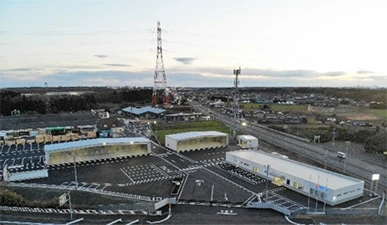
The Mito Transport Center, which was opened in Tokai Village, Naka-gun, Ibaraki in February 2021 as part of the major measure of a centralized vehicle assignment center plan, is a joint terminal not only for the Group but also for regional business partners. It has an aim of achieving efficient business operations in the entire transport ecosystem including partners by sharing transport resources in the region (cargo/vehicle information, offices, and garages, etc.).
The introduction of SSCV-Smart, an online system that connects cargo owners and transporters, will enable the center to centrally manage everything from acquisition of transport projects to vehicle assignment, issuing of driving instructions, and billing. The system is thus expected to reduce environmental load through improved business efficiency as seen by effects such as reduction in CO2 emissions and paper usage.
Operation of shared automated warehouse for EC logistics
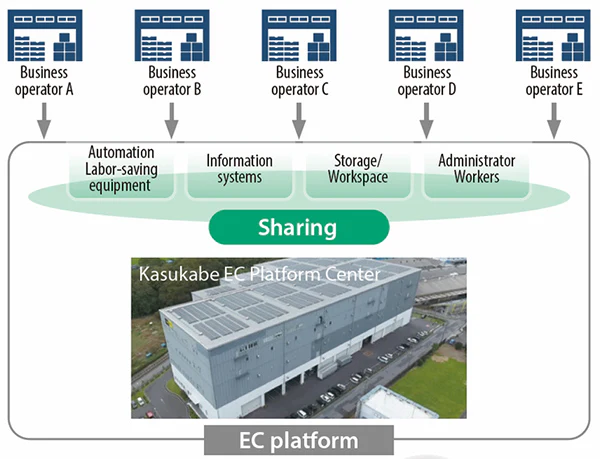
We launched an EC platform center engaging in logistics services for EC operators in 2019. This center has achieved long hour operations, including at night, with standardized operation and automated equipment, allowing us to carry out logistics operations of multiple EC operators with one platform and to improve logistics efficiency and reduce environmental load by sharing facilities and equipment.
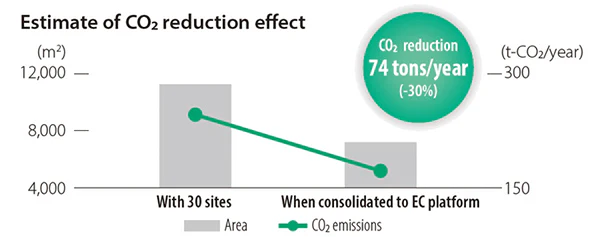
When comparing with the CO2 emissions of the traditional logistics which uses multiple sites for each EC operator, although there are some increasing factors including a rise in electricity consumption due to expanded use of labor-saving and automated equipment, if we consolidate sites of up to 30 operators to the EC platform, we can expect an approximately 30% reduction in emission in one year through improvement of energy efficiency.
This initiative was recognized, and we received "Advanced Technology Award" in the "22nd Logistics Environment Awards (2021)."
Providing decarbonization solutions to support customers in achieving GX - visualization through the SCDOS EcoLogiPortal and initiatives to utilize J-Credits -
As part of "SCDOS," our DX service to support optimization of customers' supply chain, we offer "CO2 emission visualization function" from FY2021.
This service enables customers to accurately measure and visualize CO2 emissions and reduction in the supply chain by centrally managing and monitoring their various data, which has received conformity assessment by a third-party organization.
In FY2025, the service was introduced to multiple customers, including major manufacturers and logistics companies in Japan, and its deployment progressed steadily as its scope of application expanded. We are also expanding our overseas operations and will contribute to the realization of a decarbonized society by supporting the visualization and reduction of CO2 emissions in the global logistics sector. In addition, with regard to the CO2 emissions reduction project through joint delivery, we completed registration under the J-Credit Scheme in FY2025 and are advancing initiatives aimed at the commencement of operations. Under this framework, we serve as the operating and managing entity, consolidating and calculating performance data from joint delivery undertaken by participating shippers and logistics companies, with the aim of applying for and generating credits. Going forward, we will enhance the scheme through practical operation and link it to the creation and utilization of credits, thereby delivering value to participating companies and helping to advance decarbonization in the logistics sector.