


Environmental Management

The LOGISTEED Group recognizes addressing environmental issues as a key management priority to contribute to the realization of a sustainable society. We have established an environmental management framework and are working across the entire Group to enhance environmental value.
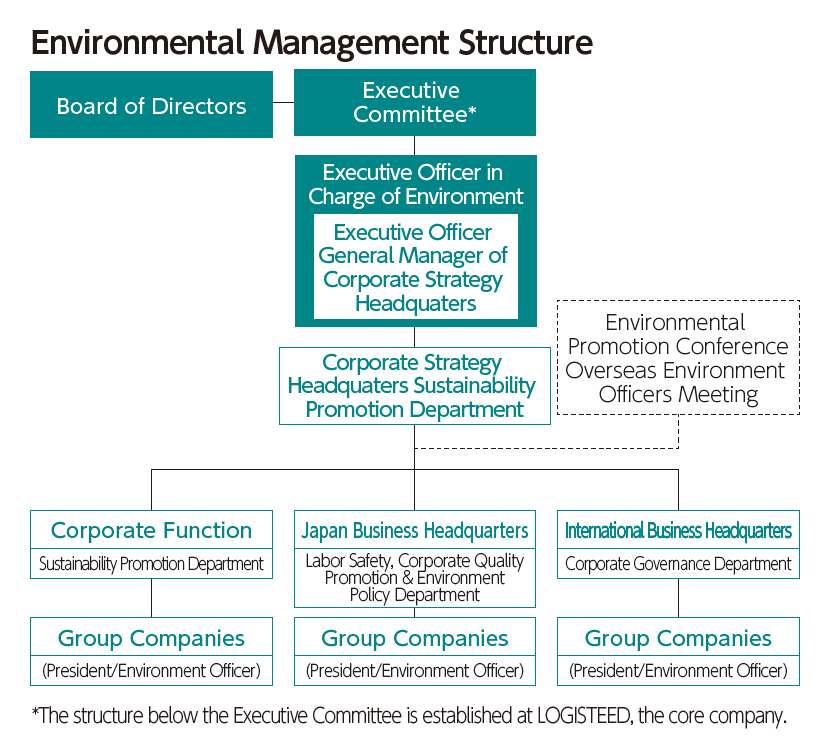
Environmental management structure
Environmental management structure
Since establishing a dedicated environmental department in August 1992, we have been advancing efforts to reduce environmental impact. Currently, we are engaged in unified global activities across the LOGISTEED Group, working toward environment-conscious business operations. Under the supervision of the Board of Directors and the Executive Committee, Sustainability Promotion Department, Corporate Strategy Headquarters chaired by Executive Officer in charge of environmental issues, is responsible for overall environmental management work and oversees the entire group.
Collaboration and coordination with external organizations
As a member company of the Japan Association for Logistics and Transport (JALoT), the Group supports the activities of JALoT by serving as a board member and taking on the role of an executive member of the organization, as well as by serving as a member of JALoT's Logistics Environment Measures Committee and presenting its views on environmental measures, including climate change issues.
JALoT is an organization that takes the lead in environmental measures, including climate change measures, in the logistics industry. It also conducts activities on behalf of the industry, such as lobbying local administration and laying the groundwork for the expansion of modal shifts, an issue facing the logistics industry.
Initiatives to strengthen environmental management
The Group is working to reduce environmental load generated at our sites by actively introducing eco-friendly vehicles and energy-saving devices for the realization of decarbonization in the business processes. The energy consumed by our group consists of electricity (approximately 30%) and fuel (approximately 70%), and we are taking the following measures to conserve energy and combat global warming.
Raising environmental awareness
Environmental e-learning
We conduct environmental e-learning programs annually for employees in Japan and overseas to raise awareness and deepen understanding of environmental issues, including climate change mitigation, resource circulation, and biodiversity conservation.
Utilization of management system
Management systems currently in use

| System name | Introduction purpose | Number of sites/ (in parentheses: % of total sites)* as of March, 2026 |
|---|---|---|
| Industrial waste management system |
Manifest management under the Waste Management and Public Cleansing Act Improving the management level of waste and other emissions through complete renewal that emphasizes operability and efficiency |
288sites (100) |
| Environmental load research system |
Survey of energy consumption such as electricity and fuel under the Act on Rational Use of Energy, etc. Improvement of accuracy of environmental load data by improvement of input/aggregation operations |
391sites (100) |
| Vehicle management system |
Management of vehicle fuel consumption, mileage, registration information under the Act on Rational Use of Energy, the Law Concerning Special Measures for Total Emission Reduction of Nitrogen Oxides and Particulate Matter from Automobiles in Specified Areas, etc. Improvement of vehicle management levels by improving operability and functionalities |
547sites (100) |
| Overseas CO2 emissions management system |
Management of energy consumption, including electricity and fuel, based on the GRI Standard. Improvement of the accuracy of environmental load data through improved data entry and aggregation processes |
388sites (100) |
Initiatives to set CO2 emission reduction targets throughout the supply chain
To set CO2 emission (Scope 3) reduction targets throughout the supply chain, we have been conducting fact-finding surveys of CO2 emissions in overseas group companies and building a system to calculate and visualize emissions with higher accuracy since FY2022. For our overseas operations, Scope 1 and Scope 2 CO2 emissions were monitored and aggregated monthly in FY2025 using the CO2 emissions visualization system already implemented, consistent with the approach adopted in Japan. In addition, Scope 3 emissions are calculated based on an established methodology and reporting framework.
Boosting of the management level through continuing training and conferences
We are working to improve the level of environmental management through a variety of training and meetings.
Training aimed at maintaining and improving the level of environmental management
We strive to maintain and improve the level of environmental management by continuously conducting environmental training.
- a. Training for waste management personnel
- We continue to provide training for employees in charge of waste management aiming at promoting treatment that complies with laws and regulations without fail, leading to proper management of waste and improvement of the recycling rate.
- b. Training for environment management operation
- We have been working to foster environmental awareness by continuously conducting environmental education for new employees, new assistant managers and managers. In FY2025, the education focused on understanding social trends and growing expectations of corporations regarding SDGs and ESG investment, as well as understanding business activities toward decarbonization and sharing of specific examples of activities at each site.
Maintaining and increasing of waste recycling rate
Holding environmental promotion conference
We share environmental information in Japan and overseas to improve environmental awareness and the management level.
| Number of environment conferences held (FY2025) |
Japan: environmental promotion conference 2 times |
|---|---|
| Overseas: environmental officers meeting 2 times |
Performance of internal environmental audit
We perform internal audit to prevent or promptly correct violations of the environmental compliance and improve the management level.
| Number of sites audited (Japan) (FY2025) |
114 sites |
|---|
Third-party certification Initiatives
We seek third-party certification and the Sustainability Promotion Department has acquired the "Eco Stage" certification.
From FY2017, we have upgraded the certification level to "Eco Stage II" which is equivalent to ISO14001, and are rolling out an environmental management system across the entire company and otherwise working to improve the level of environmental management at the Group as a whole.
In FY2019, LOGISTEED Central Japan, Co., Ltd., our group company, independently acquired "Eco Stage II Certification," and has been continuously renewing it.
Scope: LOGISTEED, Japan group companies
| Scope of Eco Stage 2 |
|---|
| 474 sites (All sites in Japan as of the end of March 2026) |

Eco Stage II Certification
Third-party certification on CO2 emissions data
In FY2025, we obtained third-party assurance for our FY2024 greenhouse gas (GHG) emissions, covering Scope 1, 2, and 3 in Japan, and Scope 1 and 2 overseas, based on ISO14064-3:2019 through an audit by the assurance provider LRQA Limited. We will continue working to ensure the reliability of our calculated values by receiving third-party assurance on an ongoing basis.
Relating to GHG Emissions for the FY2024 (PDF format, 538kBytes) 
Environmental compliance
Non-compliance with environmental laws and regulations
The number of non-compliance with environmental laws and regulations at LOGISTEED in FY2025 was 0.