

Climate Change and TCFD-Aligned Reporting

The LOGISTEED Group is working to reduce greenhouse gas (CO2) emissions including the supply chain, improve energy efficiency, and create business opportunities as part of its efforts to address climate change and achieve a decarbonized society. In September 2021, LOGISTEED also announced its support for the recommendations of the Task Force on Climate-related Financial Disclosures (TCFD) and has worked to enhance its disclosures in line with these recommendations since then.
Action Policy
Basic approach
The Group regards addressing climate change as one of its most important management priorities and has identified "Contribute to decarbonized society" as one of its material issues. The Group has also designated "Contribute to decarbonized/recycling-oriented society" as a priority business area to promote responses to climate-related risks and opportunities and initiatives to reduce CO2 emissions. As one of the targets under "LOGISTEED 2030," the Group's medium-to-long term future vision, we aim to reduce CO2 emissions by 50% by 2030 and are advancing initiatives toward this goal.
Governance
The LOGISTEED Group reports to the Board of Directors on an annual basis regarding climate change initiatives (actual greenhouse gas (CO2) emissions and reduction targets, and climate-related risks and opportunities). In FY2025, regarding climate change initiatives included in management strategies and business plans, the Board of Directors provided guidance and supervision through the Chairman and CEO, who is the officer responsible for climate change initiatives, including consistency with management strategies and the Mid-term Management Plan, key performance indicators (KPIs), and final decisions on large-scale capital investments. The Sustainability Promotion Department within the Corporate Strategy Headquarters oversees all aspects of environmental management under the supervision of the Executive Officer serving as the Chief Strategy Officer. The Environmental Promotion Conference and the Overseas Environmental Officer Meeting, comprised of the environment officers of each group company including the Chief Strategy Officer, are held semiannually to confirm the achievement level of energy consumption and CO2 emissions targets, manage the progress of climate change measures, determine necessary corrective measures, and discuss future measures. Based on the decisions at the Environmental Promotion Conference and the Overseas Environmental Officer Meeting, and with the approval of the Chief Strategy Officer, the status of climate change initiatives and proposed future strategies are reported or proposed to the Executive Committee semiannually or as needed.

| Meeting Bodies/Departments | Roles |
|---|---|
| Board of Directors |
|
| Executive Officer* |
|
| Sustainability Promotion Department* |
|
| Environmental Promotion Conference and Overseas Environmental Officer Meeting* |
|
*Established at LOGISTEED, the core company.
Risk management
The LOGISTEED Group has selected "climate change" as a priority risk, as it is a significant risk related to "contribution to a decarbonized society," which is one of our materialities. Led by the Sustainability Promotion Department of the Corporate Strategy Headquarters, we conduct evaluations in line with the TCFD recommendations annually or as needed, and manage them qualitatively and quantitatively alongside other management risks on a heat map for each company-wide risk factor to ensure consistency with our management strategy.
Strategy
The LOGISTEED Group uses a scenario analysis to identify and assess climate-related risks and opportunities that are expected to affect our medium-to-long-term business activities and also assess resilience and examine response measures.
(1)Scenario analysis process
The LOGISTEED Group conducts scenario analyses following the procedures outlined below. Under the scenario that assumes the goal of the Paris Agreement is achieved (1.5℃ /2℃ scenario) and the one that assumes that no new policies are implemented but each country's announced policies are achieved (4℃ scenario), we have assessed financial impacts of identified climate-related risks and opportunities based on the information such as the trend of key parameters.

*Reference scenario: 1.5℃ scenario: IEA Net Zero Emissions by 2050 Scenario 2℃ scenario: IEA Sustainable Development Scenario/IPCC RCP2.6 4℃ scenario: IPCC RCP8.5
(2)Assessment of climate-related risks and opportunities and financial impacts
For the 11 items identified as important climate-related risks and opportunities for the LOGISTEED Group, we used scenario analysis to quantitatively estimate the potential financial impact, and for items that could not be calculated, we organized them qualitatively. In addition, we re-evaluated the priority based on the timeline and the degree of impact. Furthermore, we examined the resilience of our current response measures and future initiatives. We are examining and implementing response measures to reduce risks and seize opportunities that have a particularly large financial impact, and we have confirmed that we possess sufficient resilience at this time.
1.Transition Risks (1.5℃ Scenario/2℃ Scenario)
| Types | Timeline* | Risks | Impact* | Priority | Measures |
|---|---|---|---|---|---|
| Policy and Legal | Mid- to Long-term |
Increased carbon costs due to tightening climate regulations and growing demand for carbon offsets | Large (up to 5.6 billion yen) |
Medium |
Develop and implement environment strategies toward carbon neutrality ①Implement renewable energy ②Implement EVs/FCVs ③Establish and implement an internal carbon pricing (ICP) mechanism |
| Short- to Mid-term |
Increased compliance costs resulting from insufficient adaptation to new disclosure obligations | Medium | Medium | ①Promote emissions data collection and control structures ②Expand the scope of emissions verification conducted by external parties |
|
| Technology | Mid-term | Increased cost of introducing low-carbon vehicles and equipment | Large | Medium | Facilitate decarbonization investment and new technology deployment through the development and operation of an internal carbon pricing (ICP) mechanism |
| Mid-term | Reduced operational efficiency due to changes in business model and operations associated with the introduction of new technologies | Large (up to 0.8 billion yen) |
Medium | Roll out company-wide in phases based on the pilot site trial results | |
| Market | Mid-term | Missed business opportunities or the loss of customers due to insufficient or delayed response to decarbonization efforts | Large | Medium | Promote decarbonization measures alongside strengthened disclosure practices ①Execute energy conservation efforts in a proactive manner supported by the decarbonization investment scheme ②Disclose information on an ongoing basis via the company website, Integrated Reports, and related publications ③Strengthen sustainable marketing communications |
| Reputation | Short- to Mid-term |
Lower investor and customer confidence driven by perceived gaps in climate change response or inadequate disclosure | Large | High |
2.Physical Risks (4℃ Scenario)
| Types | Timeline* | Risks | Impact* | Priority | Measures |
|---|---|---|---|---|---|
| Physical- Acute | Short- to Mid-term |
Amplified risk of business interruption and revenue loss linked to the increased severity of extreme weather events causing supplier and customer shutdowns, as well as damage to our own facilities and infrastructure | Large | High | Strengthen BCP measures against hazard risks ①Diversify sites ②Install solar power generation/storage battery facilities ③Relocate to regions posing lower risk ④Adjust transportation plans ⑤Secure a diverse base of business partners ⑥Implement returnable packaging materials |
| Physical Chronic |
Mid-term | Increase in cost of work environment measures due to rising temperatures | Medium | Low | Promote worker-friendly logistics operation ①Provide a comfortable workplace environment ②Promote automation/labor-saving/unmanned operations |
3.Opportunities
| Types | Timeline* | Opportunities | Impact* | Priority | Measures |
|---|---|---|---|---|---|
| Resource Efficiency |
Mid-term | Opportunity to reduce energy consumption by vehicles and CO2 emissions with advanced decarbonization | Medium | Low | Reduce energy cost by promoting decarbonization measures ①Promote energy-saving measures ②Introduce and expand renewable energy ③Introduce and expand non-fossil fuel vehicles (EVs/FCVs, etc.) ④Promote modal shift and collaborative logistics |
| Short- to Mid-term |
Cost reduction by introducing efficient logistics operations such as Smart Logistics and collaborative logistics | Large | High | ||
| Mid- to Long-term |
Establishing and strengthening our brand reputation as an environmentally responsible company by advancing 3R initiatives in packaging and waste reduction | Large (up to 8.0 billion yen) |
Medium | ①Establish a 99% resource recovery target and consistently meet the target ②Promote the 3Rs in packaging and packing materials |
|
| Energy | Mid-term | Explore efficient and stable implementation schemes for renewable and low-carbon energy | Medium | Low | Explore efficient and stable implementation schemes for renewable and low-carbon energy |
| Short- to Mid-term |
Improvement of operational performance by leveraging AI, IoT, and big data for energy usage visualization and optimization | Medium | Medium | ①Expand internal deployment of the EcoLogiPortal service for visualizing CO2 emissions during transportation ②Investigate and consider the adoption of EV energy management technologies |
|
| Products and Services |
Short- to Long-term |
Market expansion through focused research and development into decarbonization logistics technology and delivery of low-carbon services | Large (up to 5.5 billion yen) |
High | Provide low-carbon services using the Company's unique Smart Logistics ①Smart Warehouses ②EcoLogiPortal ③SSCV-Safety |
| Market | Short- to Mid-term |
Creation of revenue streams in climate change-focused markets via CO2 emissions visualization solutions and energy infrastructure |
Medium | Medium | Expand external sales of EcoLogiPortal and accumulate heavy machinery know-how |
| Resilience | Long-term | Securing and maintaining of customer trust by promoting BCP | Large | Low | Provide resilient operations that enable logistics services "that never stop" |
- *Timeline definitions: Short-term: Up to one year; Mid-term: Two to five years; Long-term: Six years or more
- *Definition of impacts: Large: It has a significant business and financial impact Medium: It has some business and financial impact Small: It has a small business and financial impact
(3)Transition Plan to Achieve 1.5℃ target
The LOGISTEED Group has incorporated the five initiatives toward the realization of the medium-to-long-term environmental targets (energy saving, electrification, procurement of renewable energy, energy creation, and emissions trading) in the Mid-term Management Plan "LOGISTEED2027" and will promote CO2 emission reduction measures to limit the temperature increase to 1.5℃ above pre-industrial levels.
Targets and Performance
The LOGISTEED Group developed the medium-to-long-term environmental targets 2030/2050 in FY2020 to contribute to the realization of sustainable society, and is striving to reduce CO2 emissions.
CO2 emission reduction targets
The Group developed the medium-to-long-term environmental targets 2030/2050 in FY2020 to contribute to the realization of sustainable society, and are striving to reduce CO2 emissions. Amid the accelerating movements to realize a decarbonized society around the world, the Group updated the medium-to-long term environmental targets 2030/2050 developed in FY2020 with more aggressive targets in FY2021. We have launched a decarbonization promotion project to achieve the medium-to long-term environmental targets and is working proactively on initiatives in five areas (1.Energy saving, 2.Electrification, 3.Procure renewable energy, 4.Energy creation, 5.Emissions trading).
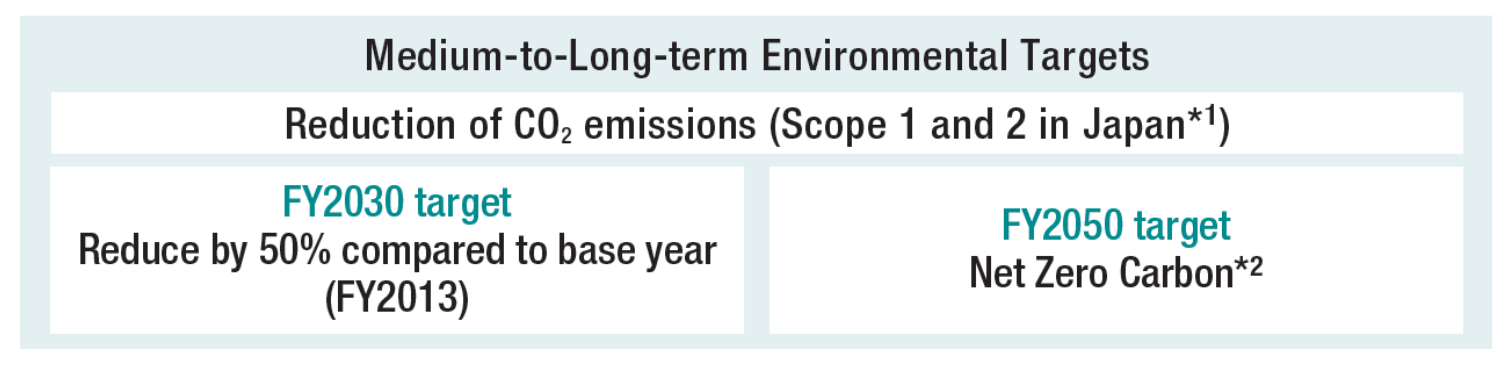
- *1Definition of scope
・Scope 1: Direct emissions from in-house energy (fuel, etc.) use (e.g. CO2 released by company vehicles)
・Scope 2: Indirect emissions from the use of energy supplied by other companies (e.g. CO2 released by a third-party power plant due to electricity use in the company's facility)
・Scope 3: Indirect emissions by supply chain other than Scope 1 and 2 (total of 15 categories including) - *2Net Zero Carbon: To balance emissions of CO2, one of greenhouse gases, and its absorption/removal
Five areas in decarbonization promotion project
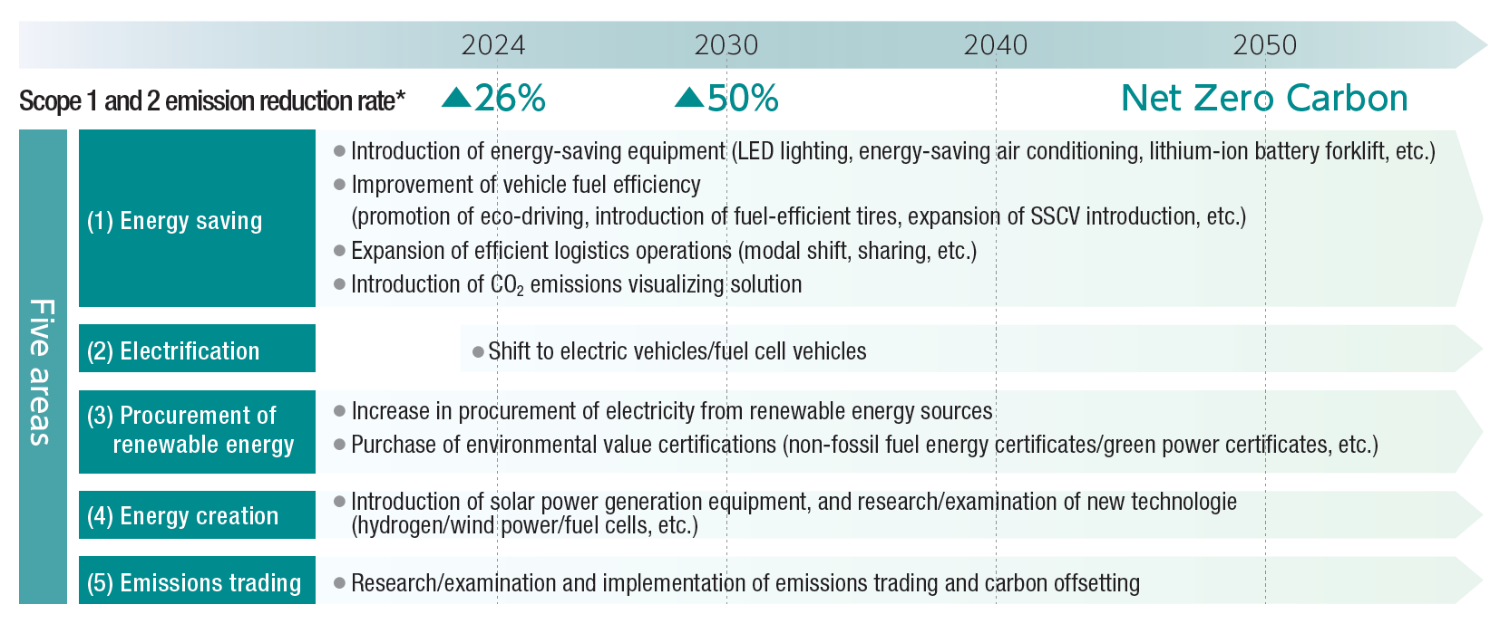
Please refer to "Integrated Report 2026" for details of the medium-to-long-term environmental targets.
Integrated Report 2026 "Medium-to-Long-term Environmental Targets 2030/2050" (PDF format,631kBytes) 
Trend of CO2 emissions and intensity per revenues
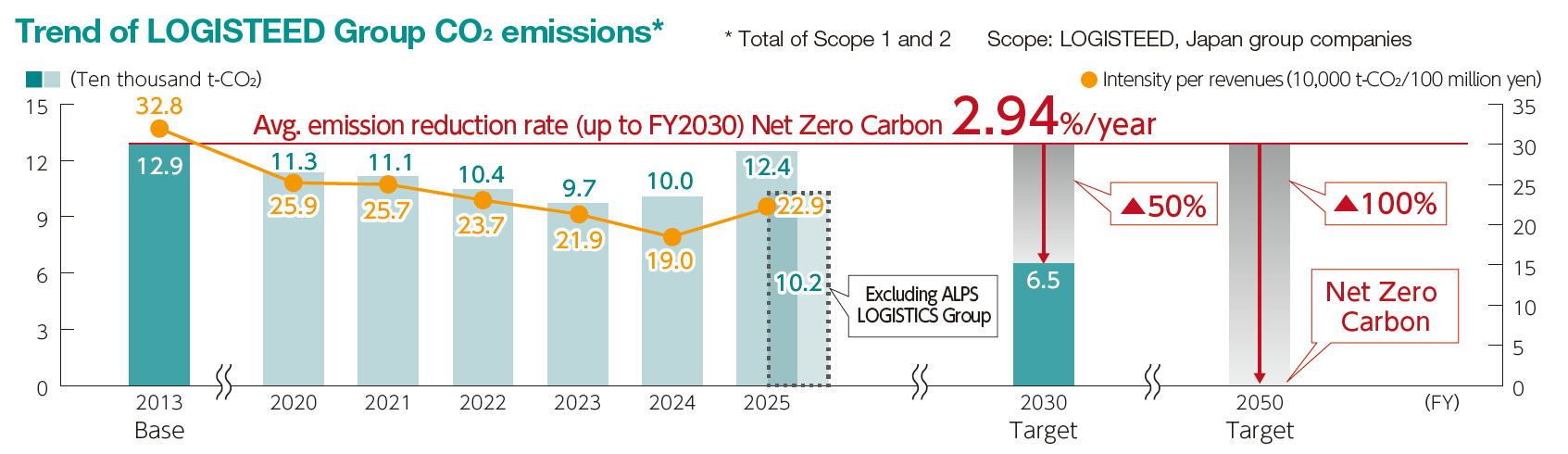
Scope: LOGISTEED, Japan group companies
| FY2021 | FY2022 | FY2023 | FY2024 | FY2025 | |
|---|---|---|---|---|---|
| Scope 1 (t-CO2) | 40,519 | 40,641 | 41,267 | 50,568 | 58,684 |
| Scope 2 (t-CO2) | 70,097 | 63,316 | 55,823 | 49,792 | 65,699 |
| Scope 1⁺2 (t-CO2) | 110,616 | 103,957 | 97,091 | 100,360 | 124,383 |
| Intensity per revenues (tons-CO2 / 100 million yen) | 25.7 | 23.7 | 21.9 | 19.0 | 22.9 |
Third-party certification on CO2 emissions data
*Due to rounding to the nearest whole number, totals and breakdown totals may not match
Scope1 total emissions (FY2025)
Scope: LOGISTEED, Japan group companies
Global warming coefficient used: IPCC Fifth Assessment Report (AR5-100 year values)
| Greenhouse Gas | Scope 1 emissions (CO2 equivalent) |
|---|---|
| CO2 (ton) | 58,684 |
| CH4 (ton) | 0 |
| N2O (ton) | 0 |
| HFC (ton) | 2,602.8 |
| PFC (ton) | 0 |
| SF6 (ton) | 0 |
| NF3 (ton) | 0 |
Scope2 total emissions (FY2025)
Scope: LOGISTEED, Japan group companies
| Scope2 | FY2021 | FY2022 | FY2023 | FY2024 | FY2025 |
|---|---|---|---|---|---|
| Market-based emissions(t-CO2) | 70,097 | 63,316 | 55,823 | 49,792 | 65,699 |
| Location-based emissions(t-CO2) | 71,263 | 66,473 | 65,247 | 67,546 | 71,766 |
Scope3 CO2 total emissions and breakdown (share of CO2 emissions by category)
Scope: LOGISTEED, Japan group companies
| FY2021 | FY2022 | FY2023 | FY2024 | FY2025 | |
|---|---|---|---|---|---|
| Scope3(t-CO2) | 513,312 | 590,518 | 512,363 | 560,260 | 1,104,732* |
*Expanded the calculation scope and reviewed calculation methodologies from FY2025
Scope: LOGISTEED, Japan group companies
| Category | Active data | Rate |
|---|---|---|
| 1 |
|
85.7% |
| 2 |
|
0.7% |
| 3 |
|
1.9% |
| 4 |
|
0.0% |
| 5 |
|
0.7% |
| 6 |
|
0.7% |
| 7 |
|
4.1% |
| 8 |
|
0.0% |
| 9 |
|
0.0% |
| 10 |
|
0.0% |
| 11 |
|
5.7% |
| 12 |
|
0.3% |
| 13 |
|
0.2% |
| 14 |
|
0.0% |
| 15 |
|
0.0% |
CO2 emissions throughout the supply chain
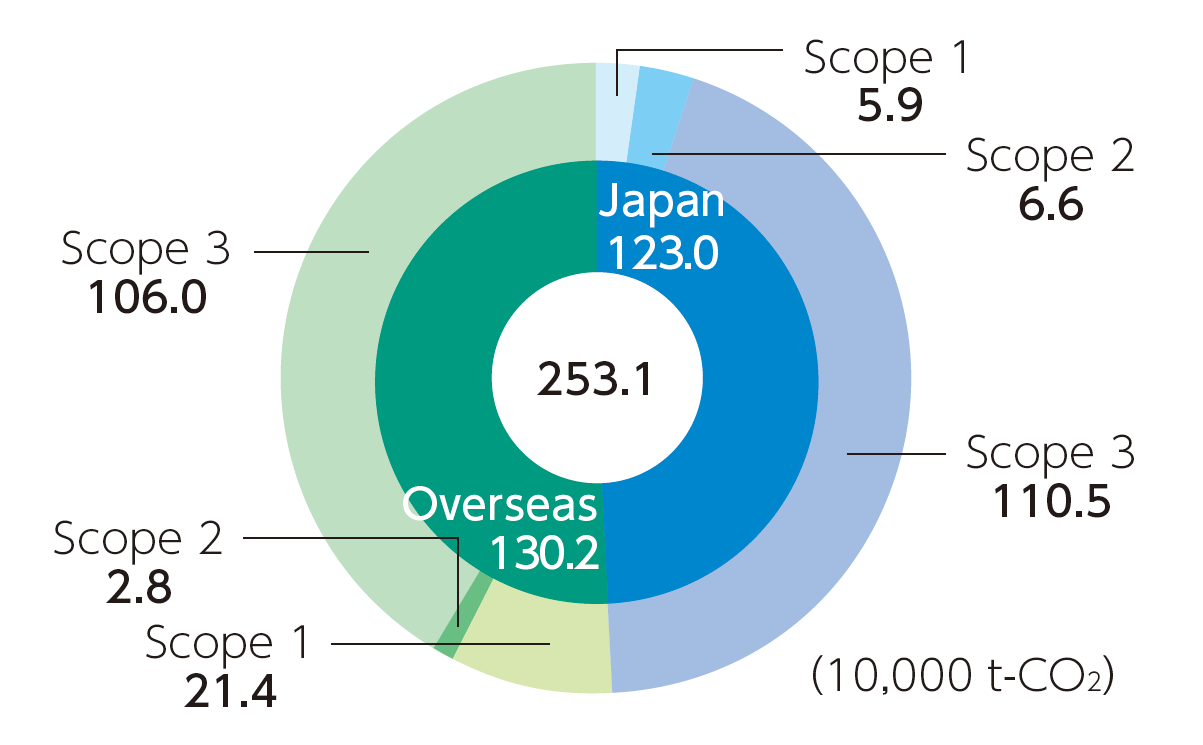
We began calculating overseas Scope 3 emissions from FY2025 to identify CO2 emissions across our entire supply chain and work toward future reductions.
FY2025 LOGISTEED Group CO2 Emissions
*Scope: LOGISTEED, Japan and overseas group companies
unit:10,000t-CO2
| Item | Japan | Overseas | Total |
|---|---|---|---|
| Scope1 | 5.9 | 21.4 | 27.3 |
| Scope2 | 6.6 | 2.8 | 9.4 |
| Scope3 | 110.5 | 106.0 | 216.5 |
| Total | 123.0 | 130.2 | 253.1 |
*Due to rounding to the nearest whole number, totals and breakdown totals may not match
Environmental protection investment and cost (FY2025)
(Millions of yen)
| Category | Investment | Cost |
|---|---|---|
| 1. Cost within our business activities | 1,740.8 | 5,297.3 |
| 2. Upstream and downstream costs | 0 | 0 |
| 3. Managerial activity costs | 0 | 947.8 |
| 4. R&D costs | 0 | 0 |
| 5. Social efforts costs | 0 | 4.2 |
| 6. Other costs | 0 | 0 |
| Total | 1,740.8 | 6,249.3 |
Aggregation method
- Reporting period: April 1, 2025 - March 31, 2026
- Scope: LOGISTEED, Japan group companies
- Reference source: "Environmental Accounting Guidelines 2005" published by the Ministry of the Environment
Energy consumption (crude oil equivalent)
Unit: kl/(inside parenthesis): composition ratio
Scope: LOGISTEED, Japan group companies
| Electricity | Gas oil | Gasoline | Other | Total* | |
|---|---|---|---|---|---|
| FY2025 | 37,689(62.9) | 18,981(31.7) | 1,766(3.0) | 1,435(2.4) | 59,884(100) |
| FY2024 | 33,899(67.1) | 14,385(28.6) | 661(1.3) | 1,498(3.0) | 50,443(100) |
| FY2023 | 33,206(67.9) | 13,482(27.6) | 665(1.4) | 1,583(3.1) | 48,937(100) |
| FY2022 | 39,393(72.5) | 12,662(23.3) | 717(1.3) | 1,590(2.9) | 54,362(100) |
| FY2021 | 42,330(73.9) | 12,755(22.3) | 791(1.4) | 1,379(2.4) | 57,255(100) |
*Due to rounding to the nearest whole number, totals and breakdown totals may not match
Initiatives
The Group is working to reduce environmental load generated at our sites by actively introducing eco-friendly vehicles and energy-saving devices for the realization of decarbonization in the business processes. The energy consumed across our Japan and overseas Group companies consists of approximately 70% fuel and 30% electricity, and we are taking the following measures for energy conservation and climate change mitigation.
Promotion of modal shift
Modal shift in Japan
The Group is actively promoting modal shift from truck transport to rail and sea transport with the goal of developing new customers and new routes in order to reduce CO2 emissions and alleviate the shortage of truck drivers.
Newly developed routes and customers (cases)
| Type | Year | Number of cases | Routes/Cases | Details |
|---|---|---|---|---|
| Rail | FY2025 | 10 | 13 routes |
|
| Ship | FY2025 | 6 | 7 routes |
|
Promotion of overseas intermodal*
We have introduced special containers to promote modal shift not only Japan but overseas and reduce CO2 emissions globally.
Our Turkish group company, MARS LOGISTEED GROUP LOJISTIK ANONIM SIRKETI focuses on intermodal transport, which combines different transport modes such as rail, trailer trucks, and ships. Between 2012 and 2025, the company carried out approximately 200,000 rail shipments on designated routes to and from Turkey, and these shipments reduced CO2 emissions by approximately 310,000 tons compared to truck transport. We will continue to accelerate supply chain decarbonization and promote the provision of sustainable transport modes.
*Intermodal: Multimodal transportation combining trucks, ships, railroad, etc.
Modal shift of recyclable resources waste transportation
We contribute to the reduction of CO2 emissions by further promoting modal-shift to the sea transport in transporting recyclable materials such as waste plastics segregated from wastes.
We had been implementing a modal shift to transportation with ships using self-developed containers for recycled materials. In FY2019, we introduced new containers and achieved further efficiency improvement.
This is due to the fact that the introduction of new containers has made it possible both to increase load capacity and shorten unloading time, and the number of containers transported has been reduced to about two-thirds each month, and some other factors.
In addition, comparing the CO2 emissions of the case where all processes are transported by dump truck, this means that the reduction is approximately over 40%.
In recognition of these "efforts to improve transportation efficiency of recyclable resource waste transportation by developing special new transportation containers," we received the "Logistics Environment Special Award (FY2019)" at the 21st Logistics Environment Awards.
While problems such as marine plastic waste pollution have been pointed out, we will continue to contribute to solving environmental problems by promoting a modal shift and providing logistics services with less environmental load on the recycling industry.


Transport of product raw materials and finished products utilizing the same marine container
As the shortage of truck drivers becomes more serious, securing stable long-distance transport into the future has become an issue. We are working on modal shift from trucks to coastal vessels for long-distance transport between the Kyushu and Kansai regions in order to ensure stable transport. Due to the switch to coastal vessels, this initiative has resulted in a significant increase in the volume of transport per operation through such measures as cooperative efforts with multiple shippers and other related parties to enable containers for marine transport to also be used for domestic transport and transporting product materials domestically and exporting finished products internationally in the same container. This initiative is not only a response to the driver shortage, but also contributes to the reduction of CO2 emissions by improving transport efficiency.
- HTS Receives Advanced Technology Award at the 23rd Logistics Environment Awards (July 6, 2022)

- Eco-Ship Modal Shift Excellent Business Awards 2021 HTS Receives Shipping Modal Shift Grand Prize (May 24, 2022)
Energy saving and global warming countermeasures of vehicles
The Group strives to reduce CO2 emissions generated by vehicle fuel through such initiatives as the introduction of the advanced eco-friendly vehicles, promotion of eco-friendly driving and modal shift.
Making the shift to eco-friendly vehicles and encouraging eco-friendly driving

We are promoting the shift to eco-friendly vehicles (highly fuel efficient, low-pollution vehicles). We achieved the eco-friendly vehicle ownership ratio of 100% at the end of FY2016, except for certain special vehicles. We will further promote the shift to the advanced eco-friendly vehicles with higher environmental performance in order to reduce air pollutant emissions and will also promote eco-friendly driving, etc. to reduce environmental load.
Eco-friendly driving with the introduction of SSCV-Safety
"SSCV-Safety", developed independently by us, has been introduced to all vehicles owned by Japan group companies. This will not only prevent traffic accidents, but also to improve fuel efficiency through eco-friendly driving. SSCV-Safety detects in real time near-miss incidents such as sudden braking and steering due to insufficient distance between vehicles as well as driver fatigue, alerting the driver to help prevent accidents. The system also records daily driving data along with video images for use in safe driving guidance. Since sudden braking, sudden steering, and sudden acceleration can lead to a decrease in vehicle fuel efficiency, alerts issued while driving and safe driving instructions after exiting the vehicle have the aspect of promoting eco-friendly driving, which also contributes to improving vehicle fuel efficiency.
Introduction of double-trailer trucks

Vantec Central Logistics Corporation, our group company, introduced and operates two sets of 21-meter long double-trailer trucks under the "Project to promote CO2 emissions reduction measures in the transport sector" which is a joint project by the Ministry of the Environment and the Ministry of Land, Infrastructure, Transport and Tourism. The company has continued this project since FY2019 and will expand operation routes to further improve logistics efficiency.
FY2025 result
| Introduction vehicle | Two sets of 21-meter long double-trailer trucks |
|---|---|
| Operation route | From Fuji city, Shizuoka Prefecture to Nantan city, Kyoto Prefecture |
| Start operation | Trial operation in February 2019, Actual operation from August 2019 |
Electrification of transport vehicles

Fuel cell truck (FCV)
The Group is proceeding to introduce electric vehicles and fuel cell vehicles (FCV) to reduce the environmental impact of transportation while monitoring market trends. In FY2025, we introduced three commercial vehicles with EVs in Japan.
Example of overseas implementation
- LOGISTEED Slovakia s. r. o.
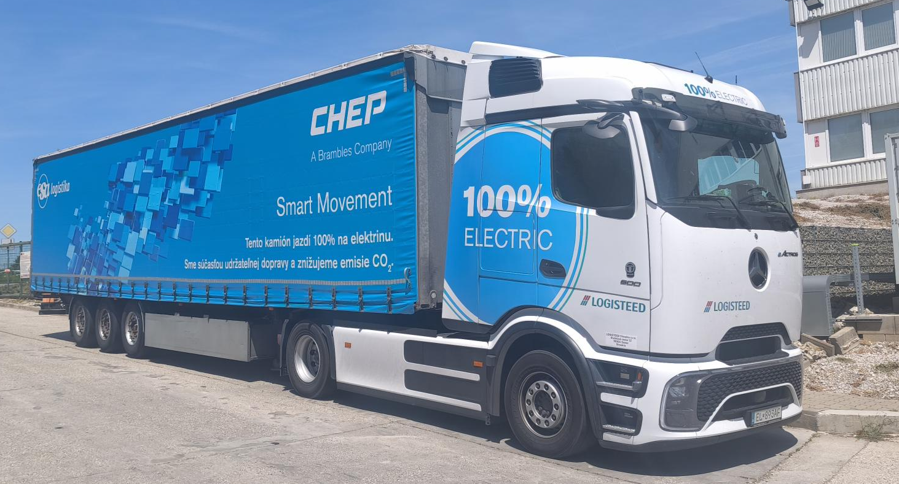
As the introduction of the Euro 7* regulations is expected to strengthen vehicle emission standards across the European Union, including those for trucks, group company LOGISTEED Slovakia s.r.o. has introduced the Volvo FM42 electric tractor and the Mercedes-Benz eActros 600. Through various tests conducted within the LOGISTEED Group, the company confirmed a maximum driving range of up to 600 kilometers for electric trucks. On the other hand, when charging is carried out using external power sources rather than the company's own solar power generation, operational challenges remain under Central Europe's current energy mix. To ensure stable operations, the company is advancing initiatives such as establishing operational rules, including battery charge monitoring and more rigorous route planning.
*Euro 7: Exhaust gas regulation applied to automobiles sold in Europe
- LOGISTEED UK LIMITED

LOGISTEED UK LIMITED, a group company in the UK, introduced in 2023 seven tractor units that run on hydrogenated vegetable oil (HVO), which is expected to be used more widely as a "next-generation biofuel" that can also make a significant contribution to reducing greenhouse gas (GHG) emissions. Those are being used for last-mile logistics on the 16-mile route from the Winsford distribution and processing site to a manufacturing site in Crewe. We have confirmed that HVO can be used without vehicle modification and that CO2 emissions can be reduced by 100%.
- Renewable energy
- We are actively switching electricity used at our offices to electricity generated from renewable energy.
- In FY2025, seventeen business sites, including the Training Institute and the Track and Field Club's club house, achieved zero CO2 emissions by implementing a 100% renewable energy plan.
Energy saving of forklifts


Since FY2021, we have been promoting the introduction of lithium-ion forklifts. Forklifts are indispensable in logistics operation in warehouses, etc. and generally powered by lead battery, but we are trying to reduce energy consumption by shifting to lithium-ion batteries with long cycle life and high charging efficiency.
Energy saving and global warming countermeasures implemented in buildings
Introduction of LED lighting fixtures

We are proactively installing LED lighting fixtures in new logistics centers and offices. We are also replacing existing fluorescent/mercury lights with LED lighting fixtures in the existing facilities and will continue until the replacement is completed in all facilities.
Using human detection sensor

Chukyo Logistics Center in Aichi Prefecture is working on power saving by using human detection sensor. To reduce power consumption by lights in the storage room when it is unmanned, we installed supplemental lights with a human detection sensor between storage shelves which light when the sensor detects the presence of workers picking up or storing products, achieving both workers' safety and power saving.
Procure renewable energy
Installment of solar panels on the roof of logistics centers

We have already installed on-site solar power generation systems for self-consumption at nine business sites and are considering expanding their deployment to additional sites. These systems have been introduced at multiple locations, generating 3,536 MWh in FY2025, which accounted for approximately 2.3% of our total electricity consumption in Japan.